
How to Choose the Right Tube Amplifier for Your Speakers: Don’t Just Rely on Specs—It’s All About Matching for Great Sound
Many audiophiles are drawn to the warm, delicate, and rich sound of tube amplifiers, but choosing the wrong one not only fails to produce good sound but can also damage the equipment—for example, When a low-power tube amplifier is paired with large floor-standing speakers, the amplifier may lack sufficient power, resulting in a somewhat weak bass response and limited overall dynamic range. Conversely, when a high-power push-pull tube amplifier is used to drive small, high-sensitivity bookshelf speakers, there is often excessive headroom, which can lead to tonal distortion and noticeable background noise, thereby compromising the listening experience.
Choosing a tube amp is never about looks or word-of-mouth; it requires strict matching based on speaker specifications. The core lies in four key metrics: sensitivity, impedance, rated power, and usage scenario. Only by combining these with the tube amp’s circuitry and output power can you make the right choice.
I. First, understand: The three core speaker parameters that determine which tube amp you should buy
1. Sensitivity (Most critical! Determines whether the tube amp has enough power)
Sensitivity unit: dB/W/m, representing the sound pressure level measured at 1 meter when 1W of power is applied to the speaker.
≥90dB: High sensitivity
85–89 dB: Medium sensitivity
≤84 dB: Low sensitivity
Key takeaway:
For every 3 dB difference in sensitivity, the required power doubles. Low-sensitivity speakers (such as floor-standing models or those with large woofers) require a higher-power tube amp; high-sensitivity speakers can be driven to a full, rich sound with a low-power single-ended tube amp .
2. Impedance (must match the tube amp’s output setting)
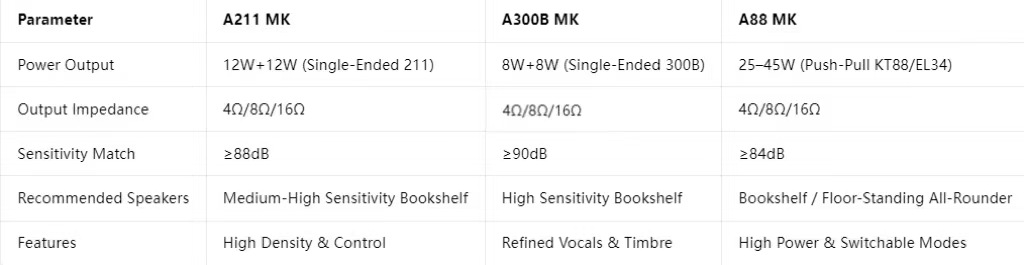
The back panel of a tube amp typically lists 4Ω / 8Ω / 16Ω output terminals.
Speaker impedance = 4Ω → Connect to the amp’s 4Ω terminal
Speaker impedance = 8Ω → Connect to the amp’s 8Ω terminal
Speaker impedance = 16Ω → Connect to the amp’s 16Ω terminal
Impedance mismatch can result in: reduced power output, dry sound, harsh high frequencies, and even burning out the output transformer.
3. Rated Power (The tube amp’s output must be able to “drive” the speaker)
The tube amp’s rated output power should be ≥ 1/2 of the speaker’s rated power; it is safer to match or slightly exceed it.
Low-power tube amps (3–10W) are only suitable for low-power, high-sensitivity speakers.
Floor-standing speakers and high-dynamic-range speakers must use high-power tube amps rated at 15W or higher.
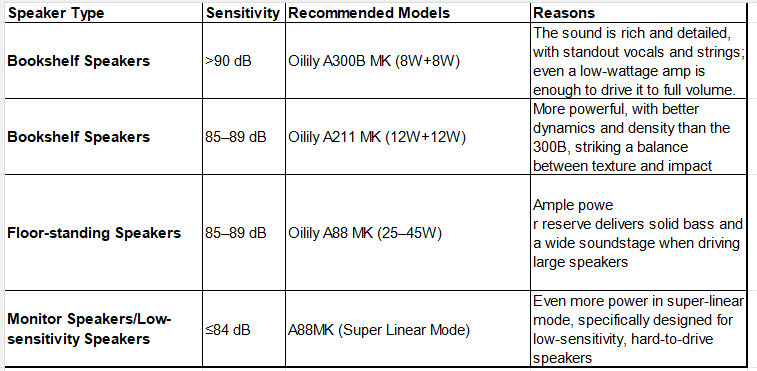
II. Matching by Speaker Type + Sensitivity: Directly Corresponding to Tube Amplifier Models (One-Step Solution)
Based on the three classic models—the Oilily A211 MK, A300B MK, and A88 MK—here is the most straightforward matching guide:
Ignoring Power for Sound Quality: A 300B sounds amazing, but it’s useless if it can’t drive your floor-standing speaker.
Mismatched Impedance: Connecting an 8Ω speaker to a 4Ω tap causes power loss and poor sound quality.
Overpowering Small Rooms: Using a 40W push-pull amp in a 20㎡ space leads to over-driving, distortion, and high noise floor.
Skipping the Warm-Up: All Oilily amps feature a 30-second mute delay. Wait for the green light before listening.
No Load / Short Circuit Operation: Never power on without speakers connected or short the output terminals—this will damage the amplifier.
V. 3-Step Guide to Perfect Matching
Check Your Speaker Specs: Note its sensitivity, impedance, and power rating.
Match to the Right Amp:
High-Sensitivity Bookshelf → 300B (A300B MK)
Medium-Sensitivity Bookshelf → 211 (A211 MK)
Floor-Standing / Low-Sensitivity → KT88/EL34 Push-Pull (A88 MK)
Verify Impedance: Match your speaker’s impedance to the corresponding tap on the amp.
The magic of a tube amp lies in perfect matching. Choose based on specs, not hype, and your speakers will reveal their true, most beautiful sound.
I have sent to many budding audiophiles and agree with every word. Good on you